Workflow Design Principles for a More Reliable Urine Testing Laboratory
Small workflow decisions in urine testing can affect turnaround time, traceability and result quality more than many laboratories expect.
Why workflow matters in urine testing
Urine analysis is often treated as a routine, high-volume activity, yet it sits at the junction of pre-analytical variability, rapid decision-making and strict traceability requirements. In many laboratories, delays or quality issues do not begin with the analyser itself, but with how samples arrive, are identified, queued and reviewed.
A well-designed workflow helps reduce avoidable repeats, supports consistent turnaround times and makes better use of staff time. For clinic managers and laboratory professionals, the aim is not simply to process more samples, but to create a system that remains reliable under both routine and peak demand.
Start with the sample journey
The most useful workflow exercise is often to map the full path of a specimen: receipt, identification, accessioning, preparation, analysis, result review, storage and disposal. This frequently reveals hidden friction points such as manual relabelling, unnecessary transfers between benches or unclear ownership of exceptions.
Urine samples can be especially vulnerable to pre-analytical inconsistency. Delays between collection and analysis, insufficient sample volume, poor container labelling and variable mixing before testing can all influence result quality. A workflow that protects sample integrity from the moment of receipt will generally deliver more benefit than one focused only on instrument speed.
Instrument placement is not a minor detail
Physical layout has a direct effect on laboratory performance. If staff must cross active walkways to load samples, fetch consumables or access a middleware terminal, small inefficiencies accumulate quickly. In a busy setting, this also increases the chance of interruptions and misidentification.
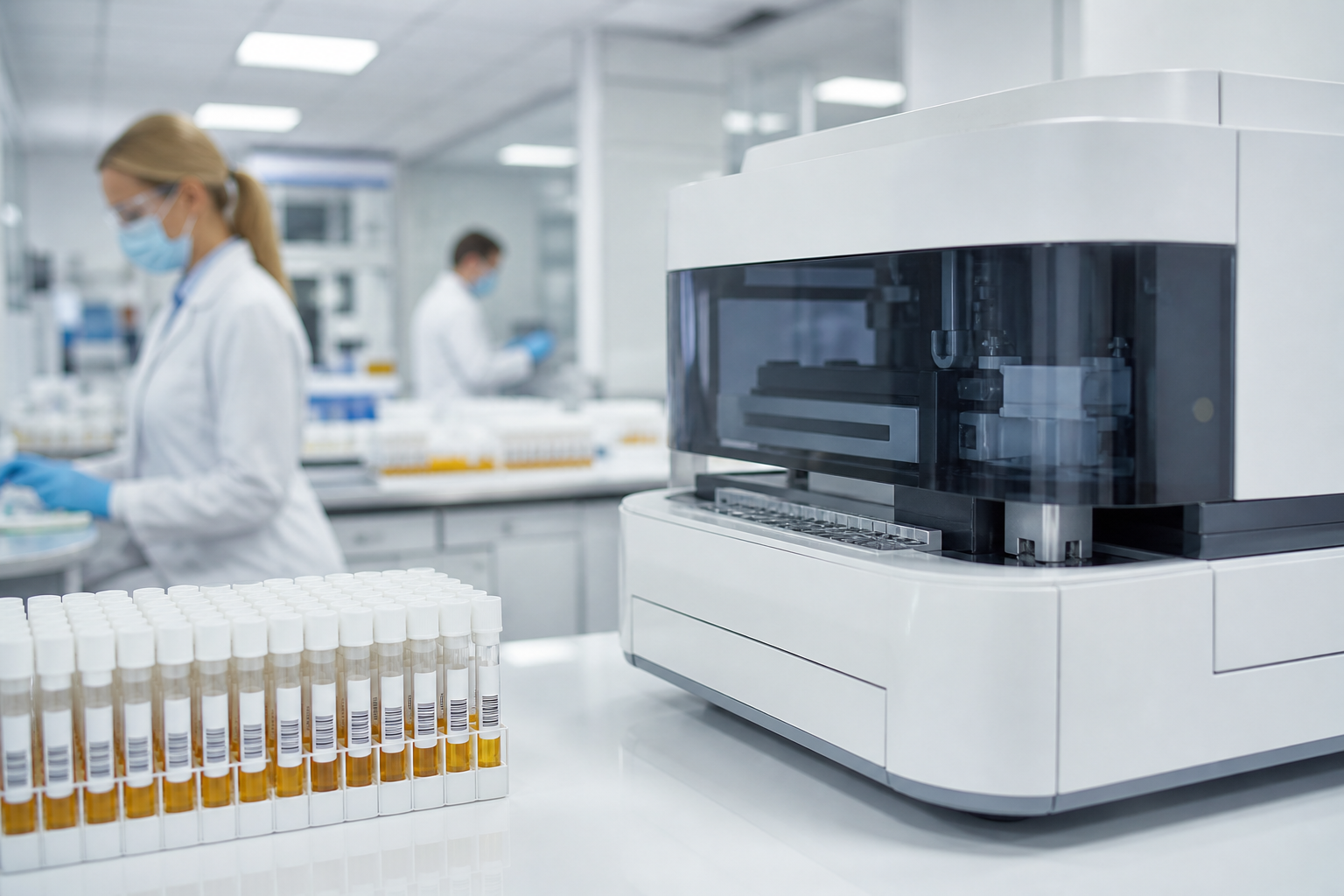
Urine analysers should be positioned to support a logical one-way movement of samples, with easy access to accessioning, reagent storage, quality control material and waste handling. Result review stations should be close enough to support efficient verification, but not placed where they obstruct loading or routine maintenance. Good layout reduces both handling time and cognitive load.
Build traceability into every handover
Urine testing workflows often involve multiple handovers: from collection point to reception, from reception to analysis, and sometimes from automated screening to microscopy or further review. Each handover is an opportunity for information loss if identifiers, timestamps or test status are not captured clearly.
Barcode-based identification, analyser connectivity and clear status tracking are now central to reliable operation. Even in smaller laboratories, reducing manual transcription should be a priority. Traceability is not only a regulatory or accreditation concern; it is a practical safeguard when investigating discrepancies, delayed reports or sample mix-ups.
Plan for exceptions, not only routine samples
Most workflows look efficient when every sample is correctly labelled, of adequate volume and destined for standard testing. The real test is how the laboratory handles exceptions. What happens when a container leaks, a barcode will not scan, sediment review is required or a clinician requests urgent processing?
A resilient workflow includes agreed rules for triage, escalation and documentation. Staff should not need to improvise each time an atypical sample appears. Clear exception pathways improve consistency and reduce the risk that urgent or problematic specimens disrupt the entire bench.
Quality control must fit the pace of work
Internal quality control is essential, but in practice it can become vulnerable when laboratories are under pressure to maintain throughput. QC routines that are difficult to schedule, awkward to document or poorly integrated with analyser software are more likely to be delayed or handled inconsistently.
Workflows should therefore make QC visible and practical. That includes clear timing, accessible materials, defined acceptance criteria and straightforward review of trends. The same applies to calibration, maintenance and lot-change checks. When these tasks are embedded in the day rather than treated as interruptions, reliability improves.
Staff practice and standardisation
Even highly automated urine testing depends on consistent operator behaviour. Differences in sample mixing, loading sequence, reflex testing decisions or result review thresholds can introduce variation between shifts. This is particularly relevant in laboratories where staff rotate between disciplines or where temporary personnel are used.
Standard operating procedures should describe not only what to do, but how the workflow should run in practice. Brief competency refreshers, visual bench guides and periodic observation of routine work can help identify drift before it affects quality indicators.
Use data to improve the process
Turnaround time, repeat rates, analyser downtime, unprocessable specimens and amended reports can all be useful workflow indicators. Laboratories often collect this information indirectly, but do not review it as a process tool. Looking at where delays cluster can help distinguish instrument issues from layout, staffing or pre-analytical causes.
Small changes can have measurable effect: repositioning supplies, adjusting sample reception cut-off times, refining autoverification rules or changing maintenance timing to quieter periods. Continuous improvement in urine analysis is usually less about major redesign and more about disciplined adjustment based on observed data.
A workflow that supports quality
In urine testing, good workflow design supports far more than speed. It helps preserve sample integrity, strengthens traceability, reduces staff stress and creates conditions for dependable results. For laboratories handling growing demand and limited resources, these are practical gains with clinical value.
When reviewing urine analysis operations, it is worth looking beyond analyser specifications and focusing on how the entire process works from collection to reporting. tech²ART can help with equipment and laboratory workflow planning where needed.