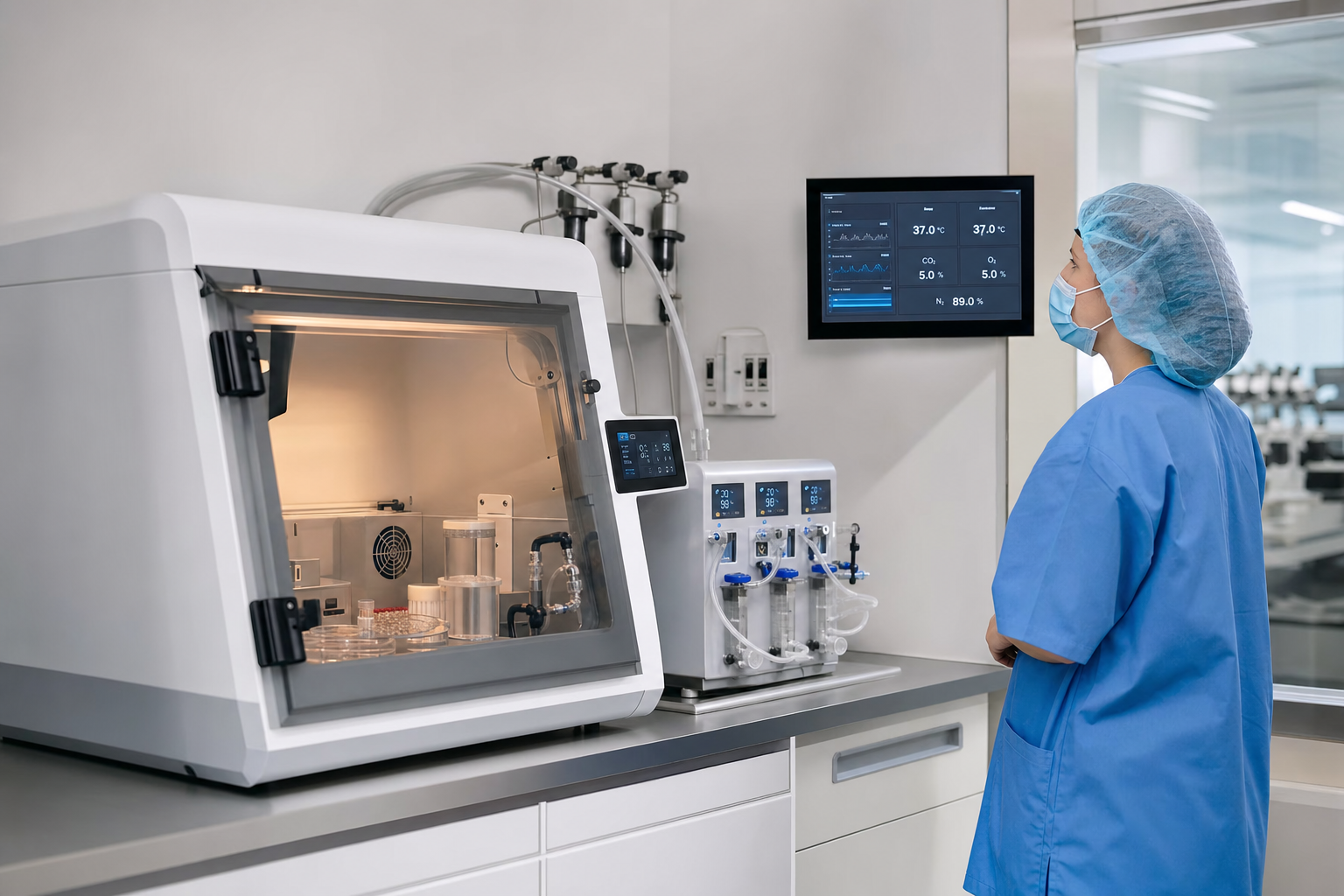
Practical Steps to Reduce Contamination Risk in Cell Culture Areas

A practical guide to lowering contamination risk in IVF and cell culture areas through workflow, zoning, cleaning and routine monitoring.
Why contamination control needs a systems approach
In IVF and cell culture laboratories, contamination events rarely come from a single dramatic failure. More often, they arise from small weaknesses that align: poor material flow, inconsistent cleaning, overfilled work areas, inadequate operator discipline, or equipment that is not maintained to specification.
For clinic managers and laboratory teams, the most effective response is to treat contamination control as a system rather than a single procedure. The objective is not only to react when contamination is visible, but to build routines that reduce microbial, particulate and chemical risk every day.
Zoning and movement through the laboratory
A well-organised culture area starts with clear separation between clean and less clean activities. Entry points, gowning practice, consumables storage, dish preparation, culture work and waste handling should follow a logical direction of movement, with as little backtracking as possible.
Even in smaller facilities, simple zoning makes a difference. Packaging should be removed outside critical work areas where feasible, high-traffic routes should not pass directly behind sterile handling zones, and waste should leave the area without crossing paths with fresh supplies. These decisions reduce airborne disturbance and the chance of introducing contamination into open work.
Getting the most from the cabinet
A biosafety cabinet or other protected work area only performs properly when operator technique supports the airflow. Blocking front or rear grilles, rapid arm movements, unnecessary talking over open vessels, and excessive equipment inside the workspace can all disrupt protection.
The practical rule is to keep the cabinet organised, calm and predictable. Place only the items required for the immediate procedure inside, arrange clean and used materials on separate sides, and complete movements slowly. Teams also benefit from standardised set-ups so that each operator uses the same layout, reducing handling errors and unnecessary reaching.
Incubators as contamination-sensitive environments
Incubators are designed to support embryo and cell viability, but warmth, humidity and frequent access can also create ideal conditions for contamination if cleaning discipline is weak. Door openings should be minimised, internal surfaces should be cleaned according to written schedules, and water reservoirs should be managed carefully using validated procedures and appropriate water quality.
It is also important to avoid using the incubator as general storage. Overloading chambers, mixing unnecessary materials, or leaving expired dishes inside increases both contamination risk and recovery time after door openings. A clear access policy, combined with routine inspection of seals, sensors and chamber condition, helps maintain a stable environment.
Consumables, media and traceability
Sterility does not end at the supplier’s label. Consumables should be checked on receipt, stored under appropriate conditions and rotated by lot and expiry date. Media preparation and handling steps should be standardised so that warming, aliquoting and exposure times are controlled and documented.
Good traceability is essential when investigating a suspected contamination event. If lot numbers for media, oil, pipette tips, dishes and cleaning agents are recorded consistently, the laboratory can identify patterns more quickly and decide whether the source is procedural, environmental or supply-related.
Cleaning that matches the risk
Effective cleaning is not simply frequent cleaning. The method, agent, contact time and sequence must fit the surface and the risk profile of the area. Benches, cabinet interiors, incubator surfaces, touchpoints and storage areas all need defined schedules, with responsibility assigned and records maintained.
Laboratories should also review cleaning agents for compatibility with sensitive culture environments. Residues, strong odours or volatile compounds may create their own problems if introduced near gametes or embryos. For that reason, product selection should be evidence-based and aligned with both equipment manufacturer guidance and laboratory procedures.
People, training and consistency
Human factors are central to contamination prevention. PPE use, hand hygiene, aseptic technique and behaviour in controlled areas must be taught, observed and refreshed regularly. Experienced staff are not exempt; in fact, routine work can sometimes lead to shortcuts unless expectations are reviewed.
Useful training is specific and practical. Rather than relying only on induction documents, laboratories should use direct observation, competency assessment and periodic retraining. When a contamination incident or near miss occurs, it should be used to strengthen the system, not merely to assign blame.
Monitoring before problems become visible
Environmental monitoring helps laboratories detect drift before it becomes a clinical issue. Depending on the setting, this may include surface sampling, particle monitoring, airflow checks, incubator performance review and trending of contamination events or unexplained culture outcomes.
The key is not to collect data for its own sake, but to review it meaningfully. Small changes in trends, repeated findings in one area, or recurring deviations after maintenance may indicate a weakness that can be corrected early. Monitoring is most useful when paired with predefined limits, escalation steps and documented follow-up.
A practical culture of prevention
The strongest contamination control programmes are usually not the most complicated. They are the ones where layout, equipment use, cleaning, training and monitoring all support one another in a consistent way.
For IVF and cell culture laboratories, that consistency protects both sample integrity and workflow reliability. tech²ART can help with equipment and laboratory solutions that support good contamination-control practice.