Validation Planning for New Laboratory Equipment: From URS to Routine Use

A practical guide to planning equipment validation so IVF and diagnostic laboratories can reduce risk, support compliance and start routine work smoothly.
Why validation planning matters early
In many laboratories, validation is treated as the final hurdle before an instrument is released for use. In practice, the most efficient validation starts much earlier, ideally when the need for new equipment is first defined. For IVF, cell culture and diagnostic settings, this matters because installation delays, unclear responsibilities and missing test criteria can affect both compliance and daily workflow.
Early planning also reduces the risk of buying equipment that is technically impressive but poorly matched to the intended process. A structured validation plan helps translate clinical and laboratory needs into measurable acceptance criteria, making later qualification more objective and easier to defend during audits.
Start with the user requirement specification
The user requirement specification, or URS, should be a working document rather than a purchasing formality. It defines what the equipment must do in the real laboratory environment. For example, an incubator URS may include chamber recovery expectations, alarm functions, data logging, cleaning requirements and compatibility with existing monitoring systems. For a urine analyser, the URS may focus on throughput, connectivity, operator access control and reagent traceability.
A useful URS distinguishes between essential requirements and desirable features. This helps avoid scope drift and makes supplier comparison more transparent. It also provides the foundation for installation qualification, operational qualification and performance qualification later on.
Risk assessment should guide the depth of testing
Not every device needs the same level of validation effort. A risk-based approach allows the laboratory to focus time and resources where patient safety, sample integrity or reportable results could be affected. Equipment used directly in embryo culture, cryostorage or diagnostic result generation will generally require more rigorous scrutiny than lower-risk ancillary devices.
Risk assessment should consider intended use, potential failure modes, environmental dependencies, software functions, data integrity and operator interaction. It is also worth assessing what could happen during routine cleaning, maintenance or power interruption. These practical issues are often more relevant to daily performance than the headline specification on a brochure.
Define responsibilities before delivery
Validation projects often slow down because laboratories, suppliers and service providers assume different people are responsible for the same task, or for none at all. Before equipment arrives, it should be clear who will prepare the site, who will verify utilities, who will perform installation checks, who will execute qualification protocols and who will review deviations.
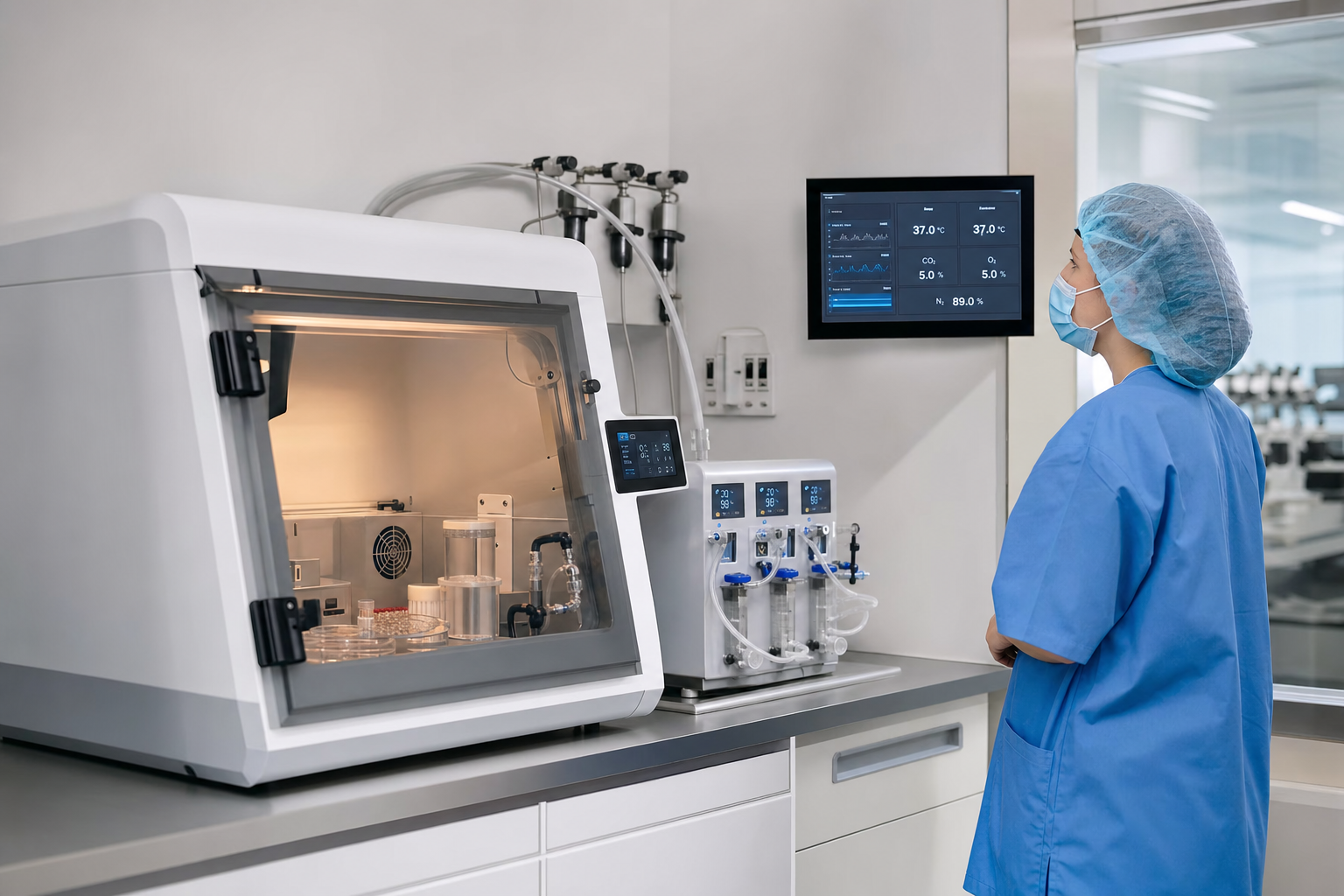
This is especially important where equipment interfaces with building systems or external gas supplies. A tri-gas mixer, biosafety cabinet or incubator may depend on room pressure, ventilation, gas quality or electrical stability. If these prerequisites are not confirmed in advance, even a well-designed validation protocol may fail for reasons unrelated to the equipment itself.
Build IQ, OQ and PQ around actual use
Installation qualification should confirm that the equipment has been delivered correctly, installed according to requirements and documented properly. This usually includes model and serial number verification, utility checks, calibration status, manuals, certificates and software version records.
Operational qualification should challenge the equipment against predefined functional criteria. The key point is relevance. Testing should reflect how the laboratory will truly use the device, not just generic factory checks. Performance qualification then demonstrates that the equipment consistently supports the intended process under routine conditions. In an IVF laboratory, that may involve environmental monitoring trends, culture performance indicators or workflow simulations rather than isolated single-point readings alone.
Do not overlook training and SOP alignment
Even well-qualified equipment can underperform if staff training is incomplete or procedures remain outdated. Validation should therefore include confirmation that operators have been trained not only on basic use, but also on alarms, deviations, cleaning, shutdown and escalation steps.
Standard operating procedures should be reviewed at the same time. Introducing new equipment often changes sample flow, maintenance frequency, documentation steps or environmental checks. If SOPs are not updated before go-live, routine use can drift away from the validated state very quickly.
Plan for data, traceability and change control
Modern laboratory equipment increasingly generates electronic records, audit trails and networked data outputs. Validation should address how these records are reviewed, stored and backed up, and whether they integrate appropriately with existing laboratory systems. This is relevant for quality oversight as well as regulatory expectations around traceability.
It is also sensible to define what changes will trigger reassessment after release. Software updates, relocation, major servicing, sensor replacement or changes in consumables may all require documented review. Validation is not a one-off event; it is part of maintaining control throughout the equipment lifecycle.
Release to routine use with clear acceptance criteria
The final release decision should be based on documented evidence that requirements have been met, deviations assessed and residual risks accepted appropriately. This review is easier when acceptance criteria were defined at the beginning, not invented at the end to fit the outcome.
For laboratory managers and senior scientists, good validation planning is ultimately about reliability. It supports consistent operation, clearer accountability and fewer surprises after handover, which is exactly what high-dependency laboratory environments need.
If needed, tech²ART can help laboratories plan equipment implementation and validation in a practical, structured way.